

How can cities harness the potential of Artificial Intelligence while ensuring that innovation remains transparent, inclusive and connected to the wider territory?
These questions were at the heart of discussions during the Private Session – Grand Paris Metropolis Club IA – Sharing Urban AI Innovations, held as part of Smart City Expo Barcelona.
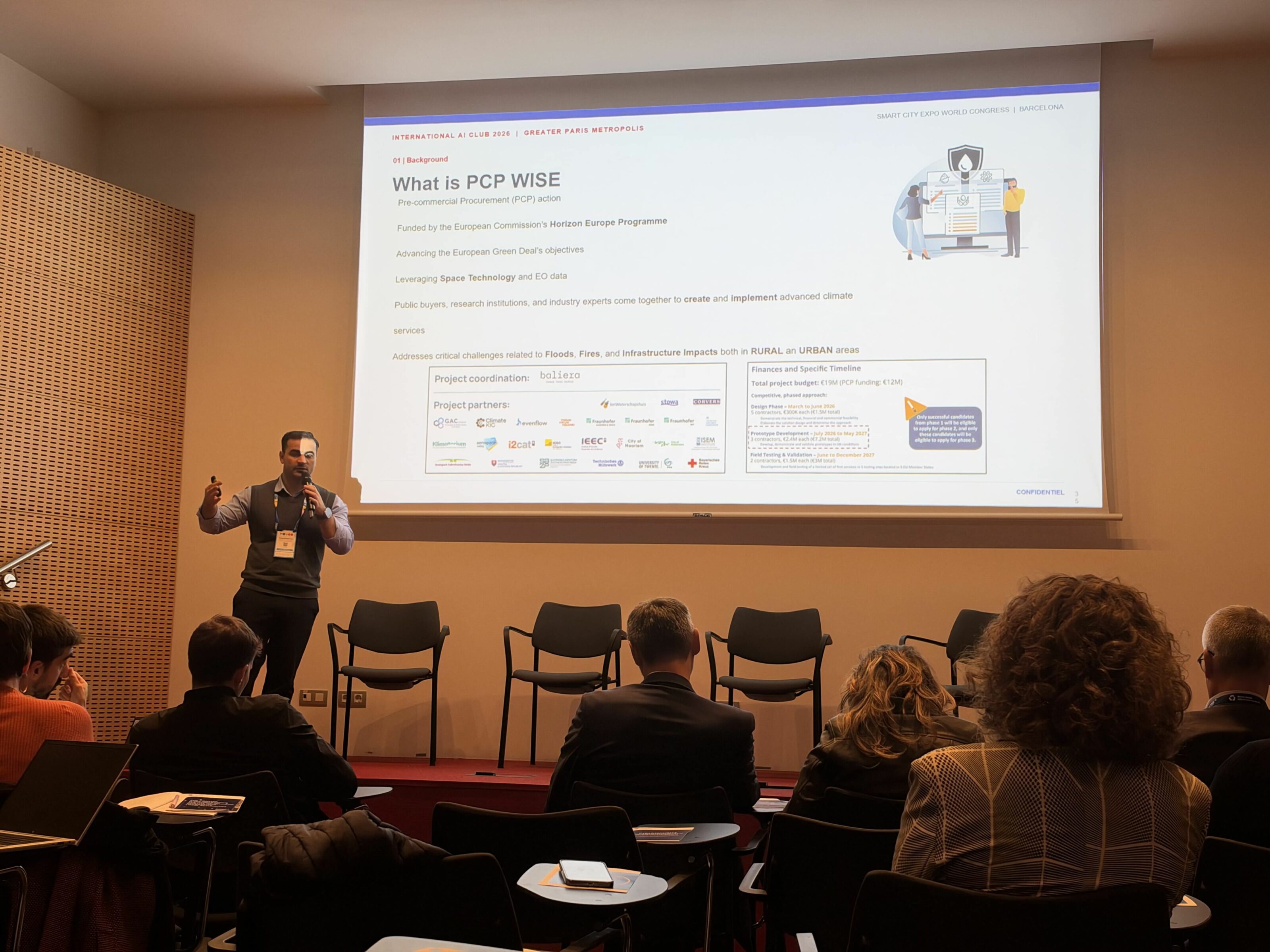
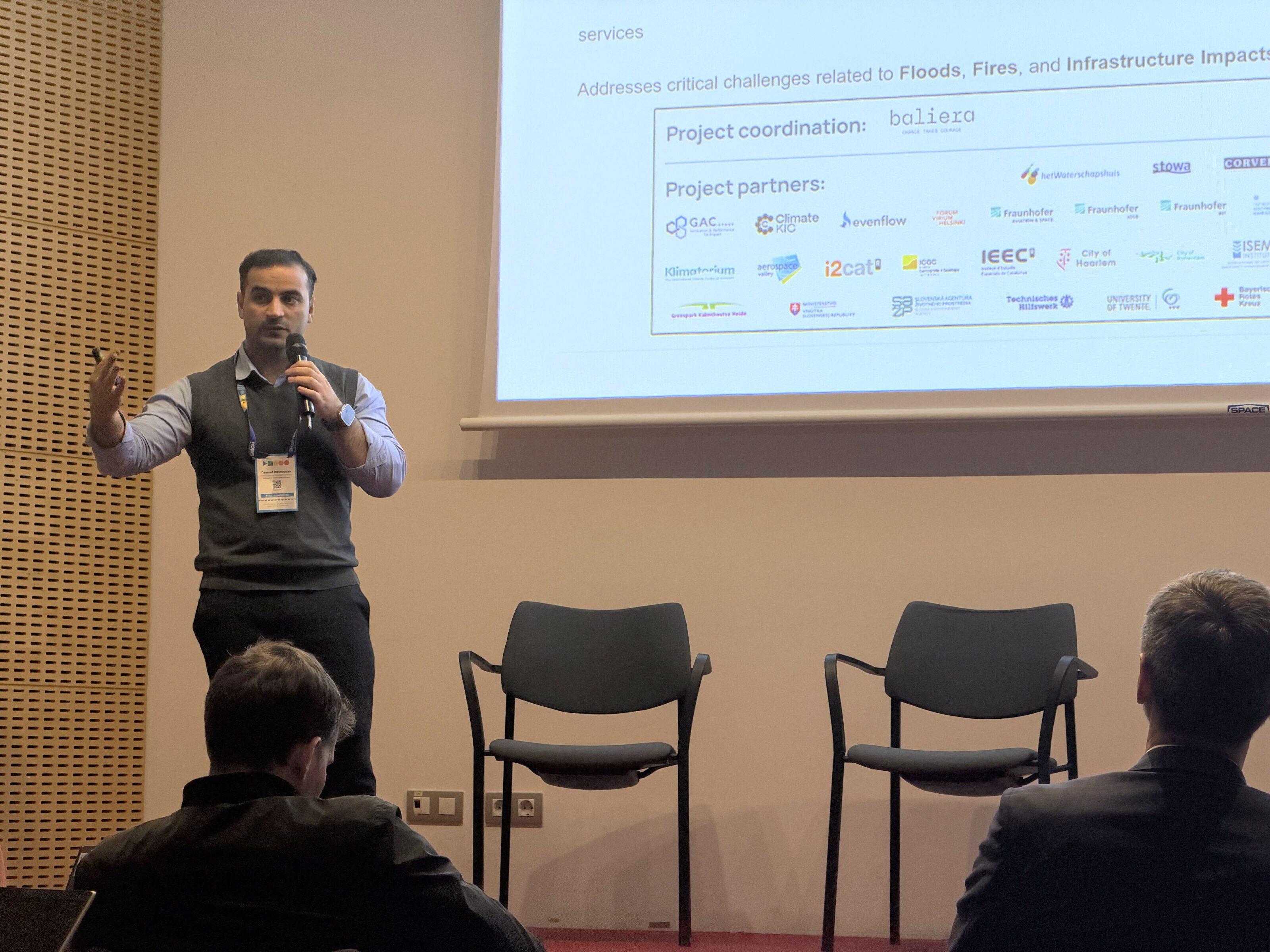
Our PCP WISE partner Davoud Omarzadeh from IEEC took part in the session, which brought together speakers and representatives from Girona (Spain), Slatina (Romania), the Institute of Space Studies of Catalonia (Spain), and Manchester (UK) to exchange experiences and perspectives on the use of AI in cities.
Cities are increasingly open to AI – but do not want to fall behind
One of the key messages emerging from the discussion was that cities are not necessarily afraid of adopting AI. Instead, city managers are increasingly concerned about keeping pace with other cities and making sure they are able to use AI effectively.
This competitive dimension is encouraging cities to become more familiar with AI and increasingly open to innovative solutions built around the technology.
At the same time, the discussion highlighted that many current AI applications in cities tend to focus on social and neighbourhood-level challenges, with less attention given to larger-scale climate and territorial issues.
Looking beyond the city itself
This is where PCP WISE can bring a complementary perspective.
The project takes a broader view of how cities and territories can respond to climate change, encouraging stakeholders to look beyond administrative boundaries and consider the connections between urban, rural and natural environments.
Climate change does not stop at the edge of a city. Understanding its impacts and designing effective responses therefore requires a perspective that considers the wider territory and the interactions between different environments.
Making AI more explainable
The PCP WISE presentation also sparked interest in the concept of explainable AI.
In particular, participants engaged with the distinction between more transparent “white-box” approaches, where the reasoning behind an AI system can be more easily understood, and more complex “black-box” models, whose decision-making processes can be difficult to interpret.
For PCP WISE, explainability is an important aspect of developing AI-based solutions that can be trusted and meaningfully used by stakeholders.
Connecting AI, climate action and territories
The discussions in Barcelona highlighted the growing role of AI in shaping the future of urban innovation. They also underlined the importance of asking where and how AI can bring the greatest value.
For PCP WISE, this means looking beyond isolated urban applications and exploring how transparent and explainable AI can help address climate-related challenges across cities, rural areas and natural environments alike.
The exchange at Smart City Expo Barcelona provided an excellent opportunity to share this perspective and to engage with practitioners and innovators working on the future of AI-enabled cities and territories.


