

Who are the PCP WISE partners driving innovation in water management and climate resilience across Europe through Pre-Commercial Procurement?
Our Partner Interview Series highlights the leading organisations in the PCP WISE consortium, showcasing their expertise, contributions, and key roles in the project.
Each partner also shares its vision of how PCP WISE advances the European Green Deal’s objectives—whether by leveraging Environmental Observation (EO) data to tackle critical challenges or pioneering innovative governance and procurement approaches like PCP.
🔍 Discover our latest interview to learn more about Fraunhofer FKIE and its impact!
Briefly introduce your organisation
 Fraunhofer FKIE develops technologies and processes with the aim of early detection, mitigation and management of existential risks. The institute covers all areas of defense and security—whether on land, in the air, at sea, underwater, in cyberspace, or in space. In close cooperation with strategic partners, the institute is dedicated to the entire data and information processing chain. The portfolio is supplemented by scientifically based forecasting, analysis, and evaluation across the entire spectrum of technological developments for defense and security.
Introduce the team working on PCP WISE within your organisation

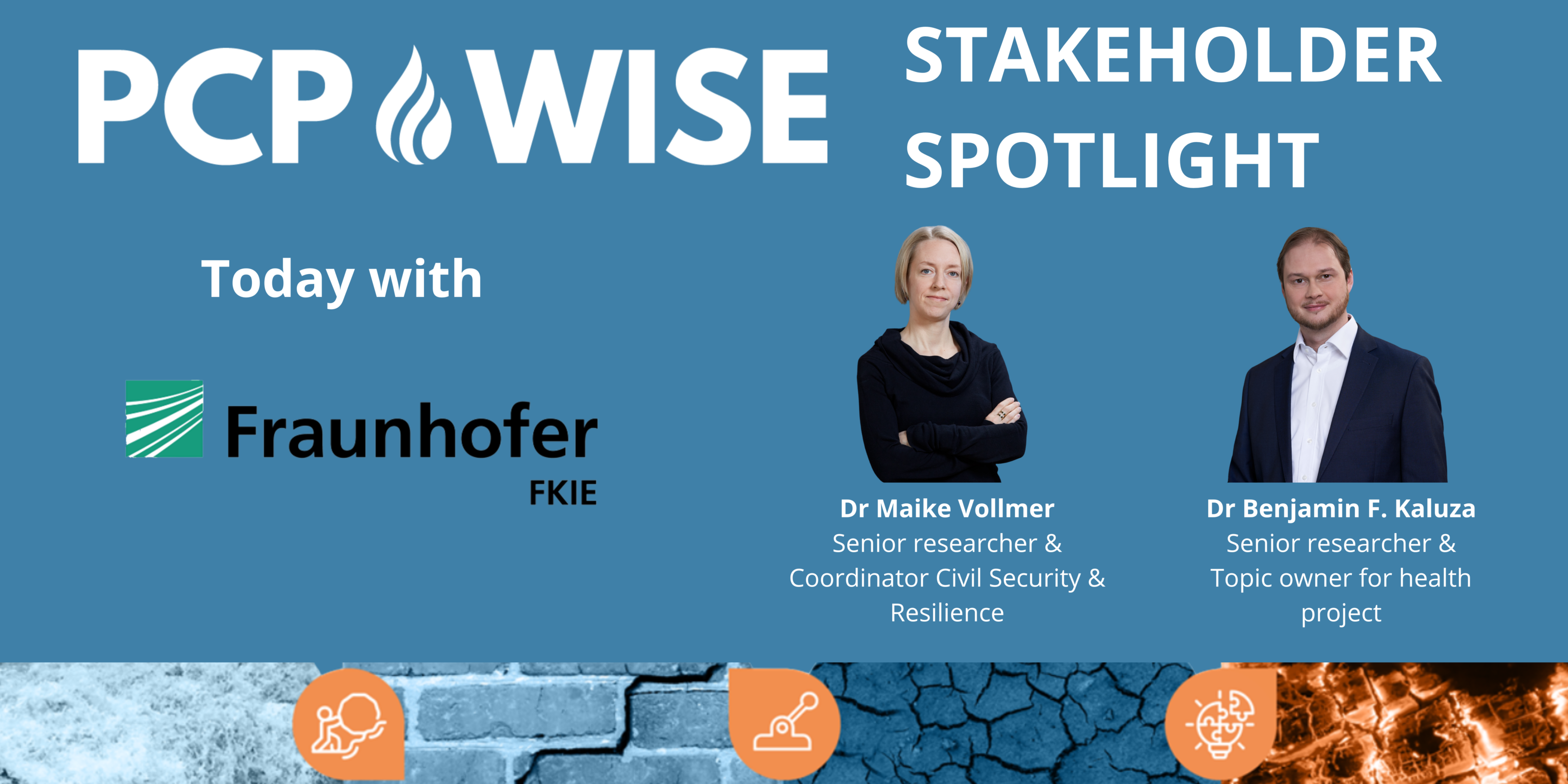
Dr Maike Vollmer is a senior researcher and coordinator civil security & resilience at Fraunhofer FKIE. Results of her PhD thesis, “Implementing innovations in disaster management to increase resilience – laws, policies, and organizational determinants”, are used for the analysis of factors that may support or hinder an actual implementation of the PCP WISE solutions.

Dr Benjamin F. Kaluza is a senior researcher at Fraunhofer FKIE and topic owner for health projects. His focus is on participatory research and co-creation in civil protection projects for EU– and national research. In PCP-WISE, he identifies with stakeholders how to identify and mitigate implementation risks, to ensure long-term adoption of solutions.
What is your organisation’s role in the project? What unique contribution does it bring to PCP WISE?
Building on previous work, FKIE’s main contribution to the project is the analysis of contextual factors for the actual adoption, implementation and use of PCP WISE solutions. The analysis covers existing barriers, possible unintended consequences of tool implementation and associated concerns, but also supporting conditions. First results serve to address potential barriers already in the solution development, to ensure that the project establishes adequate processes for their mitigation and to help shaping the solution development. In addition, insights will feed into recommendations to policies, regulations, standards, and norms.
To what extent do you think PCP WISE will contribute to enhance Europe’s ability to adapt to and mitigate the effect of climate change?
Adaptation to climate change can only be achieved through joint societal efforts. PCP WISE addresses precisely this issue and pools Europe’s capabilities to provide interoperable, scalable and decision-supporting solutions tailored to the needs of public authorities and civil protection organisations. The ability to analyse long-term climate trends together with real-time risk data supports evidence-based policy-making, early warning and more effective disaster preparedness and response.
Fraunhofer FKIE is going to contribute to this by supporting an actual implementation and use of the developed solutions.
To what extent do you think Environmental Observation (EO) and Innovation Procurement (IP) can help develop innovative solutions for water management and climate resilience across Europe?
Environmental observation and innovation procurement make a significant contribution to the development of solutions for water management and climate resilience in Europe. EO provides high-quality, continuous, and scalable data from satellite, in-situ and model-based sources, enabling a better understanding of water-related risks such as floods, droughts, and water scarcity under changing climate conditions. Integrated into decision support systems, these data facilitate early warnings, risk assessments, and long-term planning. Innovation procurement links public needs with market-oriented innovations and supports the development of interoperable, user-oriented, and scalable solutions. The combination of EO and IP strengthens resilience, improves water management, and accelerates climate adaptation measures across Europe.


