

Who are the PCP WISE partners driving innovation in water management and climate resilience across Europe through Pre-Commercial Procurement?
Our Partner Interview Series highlights the leading organisations in the PCP WISE consortium, showcasing their expertise, contributions, and key roles in the project.
Each partner also shares its vision of how PCP WISE advances the European Green Deal’s objectives—whether by leveraging Environmental Observation (EO) data to tackle critical challenges or pioneering innovative governance and procurement approaches like PCP.
🔍 Discover our latest interview to learn more about the Grenspark Kalmthouse Heide and its impact!
Briefly introduce your organisation
Grenspark Kalmthoutse Heide is an independent public-benefit foundation supporting a cross-border partnership of public authorities, municipalities, nature managers, water authorities and private landowners in Belgium and the Netherlands. The partnership coordinates a shared vision, knowledge exchange and practical projects for a 6,000-hectare nature reserve spanning the national border.
Its heathlands, fens, forests, dunes and wetlands form a highly diverse Natura 2000 landscape of major ecological and cultural value. Rather than managing all land itself, the Grenspark connects the organisations that do, enabling coordinated action on biodiversity, water, wildfire prevention, recreation, education and climate adaptation.
Introduce the team working on PCP WISE within your organisation
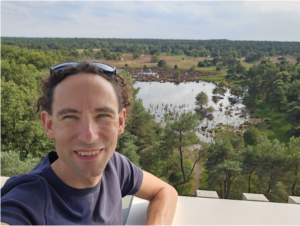
Klaas Pauly – Project Manager Nature and Water
The PCP WISE work is led within Grenspark by Klaas Pauly PhD, Project Manager Nature and Water. Klaas is a biologist and remote-sensing specialist with experience in biodiversity monitoring, applied environmental innovation, and ecohydrology using GIS, satellite and drone imagery. He translates the operational needs of nature managers, water authorities, farmers, drinking-water companies and emergency services into functional requirements and realistic test scenarios. As lead for Use Case 3—Rural Drought in Northwest-Central Europe—he coordinates stakeholder input and helps assess whether proposed solutions are scientifically sound, usable in daily practice and affordable for public and environmental organisations. Supporting this work at the Grenspark office is a team of 6 colleagues working on various aspects of park management.
What is your organisation’s role in the project? What unique contribution does it bring to PCP WISE?
Grenspark Kalmthoutse Heide participates in the Public Buyers Group and serves as lead partner and principal test site for Use Case 3: Rural Drought in Northwest-Central Europe. We bring a demanding real-world setting: a cross-border, rain-fed infiltration landscape where prolonged drought alternates with intense rainfall and rapid runoff. We ensure that solutions address genuine end-user needs—from soil-moisture and groundwater monitoring to wildfire risk, biodiversity protection and agricultural resilience. We convene local stakeholders, help define requirements and validation criteria, contribute site knowledge and data such as in-situ measurements and existing ecohydrological models, and test whether integrated water-intelligence services work across organisational and national boundaries.
To what extent do you think PCP WISE will contribute to enhance Europe’s ability to adapt to and mitigate the effect of climate change?
PCP WISE’s strongest contribution will be in climate adaptation, with mitigation co-benefits from healthier ecosystems and more efficient resource use. By turning fragmented environmental data into practical, interoperable intelligence, it can help public authorities act before drought, wildfire or flooding develops into a crisis. Better information on soil moisture, groundwater, vegetation condition and water availability will support management decisions on water retention, ecosystem restoration, emergency preparedness and long-term planning. The project also aligns regions, sectors and countries around shared methods and a common information language. Testing solutions in contrasting European settings should produce tools that are locally relevant, transferable, and scalable across borders.
To what extent do you think Environmental Observation (EO) and Innovation Procurement (IP) can help develop innovative solutions for water management and climate resilience across Europe?
Environmental Observation—particularly satellite-based Earth Observation—provides the consistent, repeated and spatial measurements needed to understand how soil, water and vegetation change over time. Combined with in-situ data and modelling, it can reveal emerging drought stress, groundwater changes, excess water and wildfire risk before these become evident through field observations alone. Innovation Procurement, especially Pre-Commercial Procurement, allows public buyers to specify the outcomes they need while competing suppliers develop and test alternative solutions in phases. This reduces development risk, keeps end users involved and directs innovation towards operational, interoperable and affordable services rather than technology for its own sake. Together, EO and IP can accelerate climate-ready water management across Europe and at the same time make it within reach also for small non-profit organizations such as Grenspark Kalmthoutse Heide and its stakeholders and end users.


